
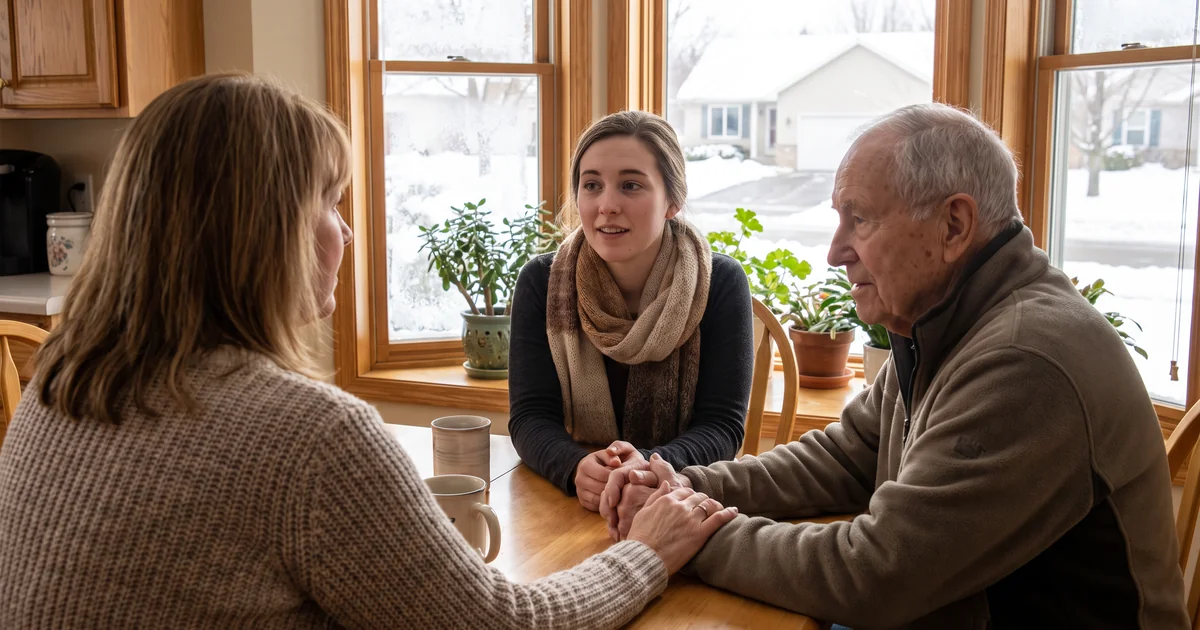
When someone you love says they do not want to be here, or you notice that they are withdrawing, giving things away, or speaking as though there is no future, it can be difficult to know what to do first. Fear often makes people quiet. It can also make them rush toward reassurance before they understand what is happening.
We encourage a different starting point: stay present, ask directly, and take what you hear seriously. You do not need perfect words. You need a willingness to remain with the person in front of you while you bring in more support.
If you believe someone may act on suicidal thoughts soon, call or text 988 Suicide and Crisis Lifeline in the United States. If there is immediate danger, call 911 or take them to the nearest emergency department. Do not leave the person alone when there is an imminent risk of self-harm.
Start the conversation without trying to fix it
A direct question does not place the idea of suicide in someone’s mind. It gives them an opening to say what may already feel unbearable. Mental health first aid guidance emphasizes direct, nonjudgmental questions and a calm response when someone discloses suicidal thoughts, rather than avoidance or alarm guidance on responding to suicidal ideation (Ross et al., 2014).
You might say:
“I have noticed that you seem overwhelmed lately, and I am worried about you.”
“Are you thinking about hurting yourself or ending your life?”
“You do not have to explain everything right now. I am here, and we can find the next step together.”
“Can we call someone together?”
Then listen. Let silence have some room. Avoid debating whether their life is objectively good, asking them to think about people who would miss them, or insisting that they “look on the bright side.” Those responses often come from love, but they can leave a person feeling more alone with their pain.
Suicidal thinking is not always expressed plainly. It may appear as hopelessness, agitation, shame, feeling trapped, increased substance use, or a sense of being a burden. Understanding suicidal ideation can help you recognize that thoughts of death exist on a spectrum, and that every disclosure deserves a thoughtful response.
Ask about immediate safety
If someone tells you they are having suicidal thoughts, it is appropriate to ask whether they have a plan, access to a method, a timeframe in mind, or an intention to act. These questions help clarify urgency. They are not an interrogation, and you do not need to conduct a clinical assessment on your own.
A useful sequence can be simple:
“Are you thinking about suicide right now?”
“Have you thought about how you would do it?”
“Do you have access to what you would use?”
“Do you feel able to stay safe tonight?”
If they have a plan, access to lethal means, intent, or cannot commit to remaining safe, treat the situation as urgent. Stay with them. Ask another trusted adult to join you if possible. Call or text 988, call 911 if danger is immediate, or go to an emergency department.
Reducing access to firearms, large quantities of medication, or other lethal means can create important time and distance during an acute crisis. Prevention guidance increasingly centers on moving beyond prediction alone and toward practical safety steps, including a clear response to changing risk work on suicide assessment and prevention (Janssen, 2025).
Support is not the same as carrying this alone
Family members and friends often feel they must become a constant monitor, counselor, and crisis responder. That is a heavy role, and it is not sustainable. A qualitative review of caregiver experiences found that loved ones may carry substantial emotional strain while trying to navigate support systems after suicidal behavior research on the caregiver experience (Marshall et al., 2023).
Your role is not to solve the entire problem. Your role is to help create a bridge to safety and care.
That may mean sitting beside someone while they call 988, helping them contact an existing therapist or prescriber, driving them to an urgent appointment, or checking in again tomorrow. It may also mean speaking honestly with other family members when secrecy would leave the person unsupported.
Keep your language grounded. Instead of promising that everything will be fine, try: “I cannot know exactly how this will feel tomorrow, but I am taking this seriously, and we are going to get more help today.”
When a loved one is reluctant to seek care
Help-seeking can be difficult when someone feels ashamed, exhausted, distrustful, or convinced that nothing can help. Anxiety about seeking help has been associated with psychological distress and suicidal ideation in research involving health-profession students, a reminder that the barrier is often emotional rather than practical research on help-seeking anxiety (Kawabe et al., 2026).
You can make the next step smaller. Offer to sit nearby while they make a call. Ask whether they would prefer texting 988, speaking with a primary care clinician, or having you help locate a mental health appointment. If they are already receiving care, encourage them to tell their provider plainly that suicidal thoughts have returned or intensified.
Depression, anxiety, trauma, bipolar symptoms, and other experiences can shape how a person understands their distress, but a crisis should not wait for a diagnosis. We encourage families to focus first on safety, connection, and a timely evaluation. For ongoing concerns, our pages on depression care in Maple Grove and anxiety care in Maple Grove offer additional context about seeking professional support.
What not to say when someone is in pain
There are phrases that can unintentionally close the conversation:
“You would never do that.”
“You have so much to be grateful for.”
“Think about what this would do to your family.”
“You are just trying to get attention.”
“Promise me you will not do anything.”
Instead, remain curious and specific. “What has made today especially hard?” can be more useful than “Why would you do this?” “What would help you get through the next few hours?” is often more manageable than asking someone to solve their whole future.
We also encourage you to take your own response seriously. Bystanders and loved ones can experience fear, guilt, and ongoing stress after learning about self-directed violence, and support for them matters too research on bystander impact (Mitchell et al., 2022).
Care after the immediate crisis
A calmer day does not mean the concern has disappeared. Follow up. Ask whether the person connected with care, whether their safety plan still feels realistic, and what they would want you to do if suicidal thoughts return.
Professional treatment can be one part of longer-term care. We provide medication management and other psychiatric services, and we discuss options carefully in the context of each person’s history, symptoms, current medications, and safety needs. Ketamine for psychiatric uses is off-label, and it is not emergency care. It should never replace calling 988, calling 911, or seeking emergency evaluation when someone is in imminent danger. If you are considering longer-term options after stabilization, our information on ketamine treatment and integrative treatment can help you prepare for a clinical conversation.
Frequently asked questions
Should I ask directly whether they are suicidal?
Yes. Ask calmly and plainly. A direct question can reduce isolation and gives you clearer information about whether urgent help is needed.
What if they ask me not to tell anyone?
You can respect their dignity without keeping a secret that puts them at risk. Tell them you care too much to handle immediate safety concerns alone, and involve 988, emergency services, or another trusted support person as needed.
What if they deny suicidal thoughts, but I am still worried?
Stay connected and continue noticing changes in mood, behavior, substance use, or withdrawal. Encourage professional support and trust your judgment if the situation becomes more concerning.
Key takeaways
Ask directly about suicidal thoughts, plans, access to means, and immediate safety.
Listen without judgment or debate.
Call or text 988 for crisis support. Call 911 for immediate danger.
Do not leave someone alone when there is imminent risk.
Help your loved one take one concrete next step toward professional support.
Seek support for yourself as well. You should not have to carry this alone.
About our care in Maple Grove
At Minnesota Ketamine & Wellness Institute, we work with people experiencing complex mental health concerns, including suicidality, with careful attention to safety, history, and the support around them. A crisis requires the appropriate level of care first. When someone is stable enough for outpatient evaluation, we can discuss whether our services may be appropriate and how they fit within a broader plan of care.
Medical disclaimer
This article is educational and is not a substitute for emergency services, medical advice, diagnosis, or treatment. If you or someone else is in immediate danger, call 911. In the United States, call or text 988 to reach the Suicide and Crisis Lifeline.
Works Cited
1. Ross WC, et al. Re-development of mental health first aid guidelines for suicidal ideation and behaviour: a Delphi study. https://pubmed.ncbi.nlm.nih.gov/25213799/
2. Janssen WC. Assessment of suicidality: from prediction to prevention. https://pubmed.ncbi.nlm.nih.gov/41147479/
3. Marshall P, et al. Caring for a friend or family member who has experienced suicidal behaviour: A systematic review and qualitative synthesis. https://pubmed.ncbi.nlm.nih.gov/36786386/
4. Kawabe K, et al. Help-seeking anxiety, psychological distress, and suicidal ideation among medical and nursing students: A cross-sectional study. https://pubmed.ncbi.nlm.nih.gov/42367576/
5. Mitchell KJ, et al. Are the Bystanders Okay? Exploring the Impact of Bystander Behavior for Self-directed Violence. https://pubmed.ncbi.nlm.nih.gov/34625376/
6. 988 Suicide and Crisis Lifeline. https://988lifeline.org/
Disclaimer
This article is for educational purposes only and is not a substitute for individualized evaluation, diagnosis, or treatment from a qualified healthcare professional.